View app installations
You can view the sites onto which your app is installed. This helps you see the following details about your app:
- the total number of current installations of your app
- a breakdown of Atlassian apps, versions, licenses, editions, and environments that your app is installed on
- whether admins have enabled logs, custom metrics, and data egress for the purpose of analytics
View app installations
To view app installations:
- Access the developer console.
- In the left menu, select Installations.
The screen shows a list of all the sites and Atlassian apps that your app is currently connected to.
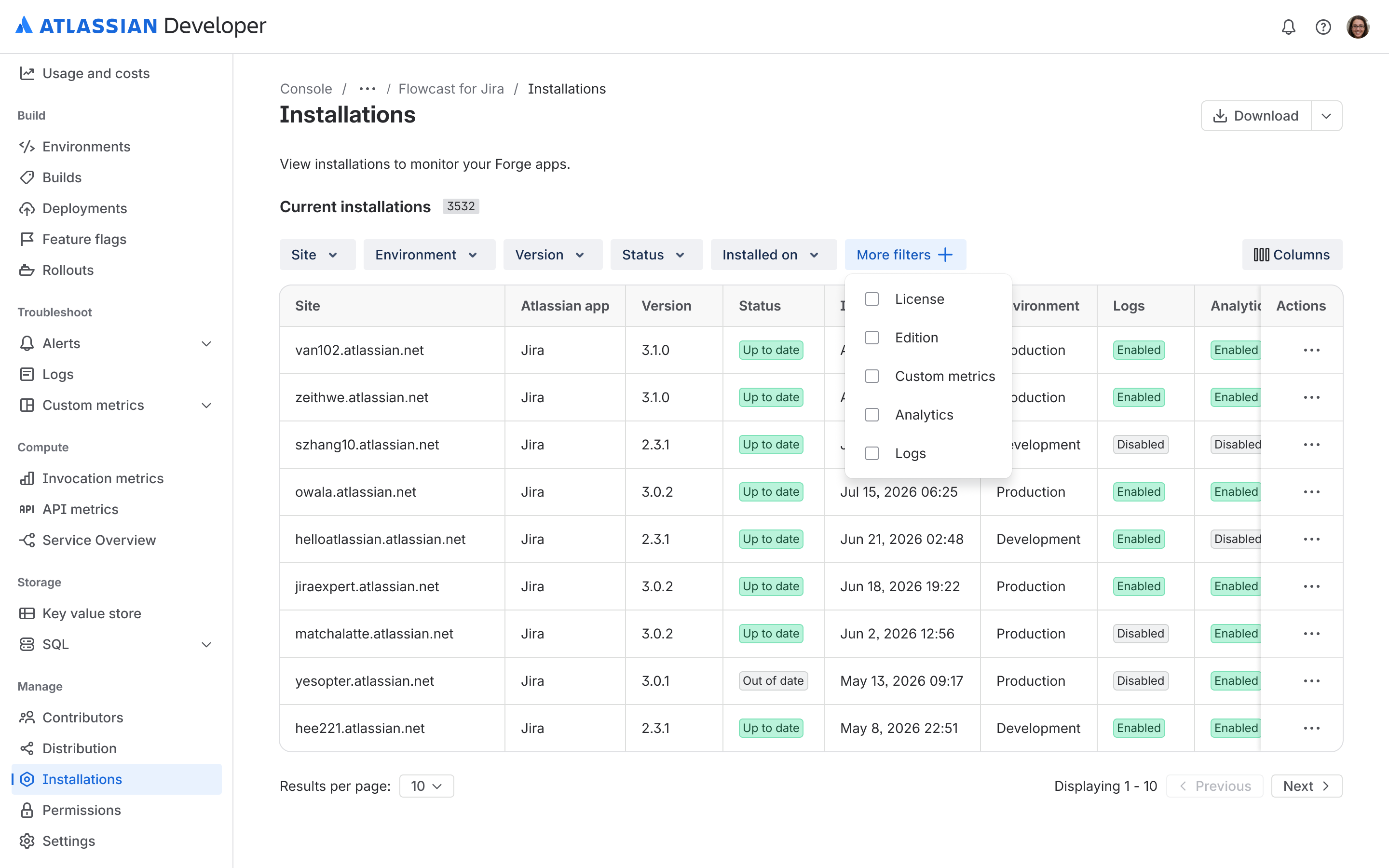
You can sort the sites by site name, version, or installation date in ascending or descending order by selecting the corresponding column header.
Customize the table
You can configure the table to show the information most relevant to you. Show or hide columns, move them left or right, and pin a column to the left. You can restore the default table configuration by resetting your selection.
Search for specific installations
You can use filters to refine the list of sites. You can filter by:
- Site, environment, Atlassian app, version, license, edition, and status.
- Installed on, including a custom date range.
- Whether logs access, analytics access, and custom metrics access are enabled or disabled.
The page shows the number of installations that match your filters above the table. You can choose to show 10, 20, 30, 40, or 50 installations per page.
Check access to analytics
For each site that your app is installed on, you can check whether or not admins have enabled the sending of data to domains that you've declared for the purpose of analytics.
While egress permissions can be categorized as analytics, app admins can still choose to disable access to analytics. You must ensure that your app can efficiently handle the scenario when analytics access is disabled. Otherwise, this may lead to poor user experience, in the form of failing app invocations or elements not rendering properly in the UI, and more.
Check access to custom metrics
For each site that your app is installed on, you can check whether or not admins have enabled custom metrics ingestion. See custom metrics for more details.
Copy a site ARI
From the Actions menu for an installation, select Copy site ARI to copy the installation context
ARI. You can use this value as the installationContext when you export app logs.
View installation permissions
From the Actions menu for an installation, select View permissions. The Installation permissions page shows the app version, the requested scopes and egress permissions, and the status of each permission.
View app logs
You can view app logs associated with a specific site. This is handy for troubleshooting issues occurring on that site.
From the Actions menu for the site you want to investigate, select View logs. This takes you to the Logs screen, where the logs are already filtered by the corresponding environment, time range, site, license, and edition.
You can do further log operations on this screen. See View app logs for more details.
Download installation details
Select Download installations to generate a CSV file containing all installation details for your app. After a file has been generated, select Download to retrieve the previously generated file immediately. The file shows the date and time through which its data is current.
To generate a new file with the latest installation data, select the More download options menu and then Download Latest. Generating a new file can take 15 to 20 minutes. Select Refresh while the file is being generated to check whether it is ready to download.
Rate this page: